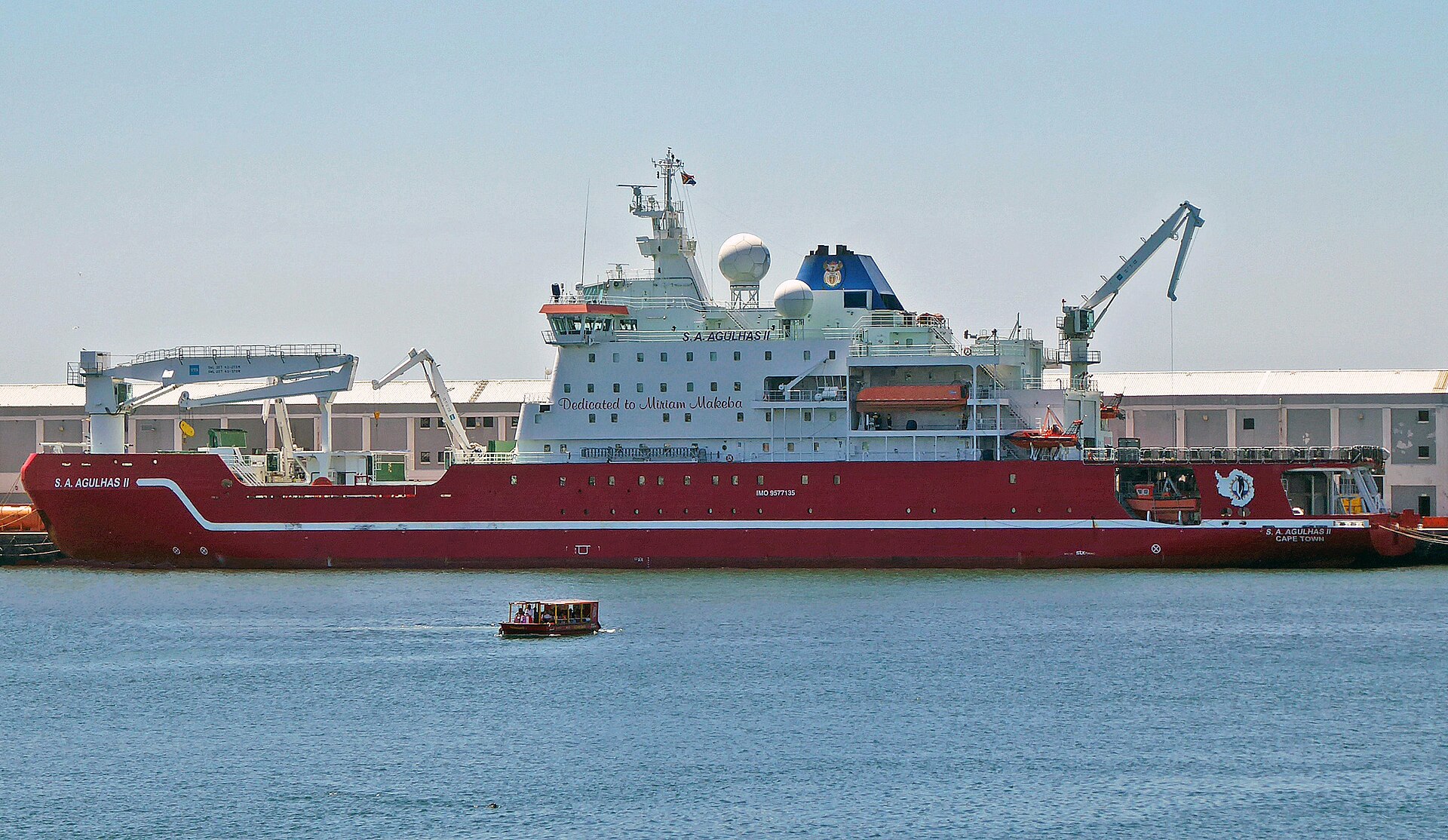
The ocean quietly absorbs roughly a quarter of humanity’s carbon dioxide emissions, slowing global warming and buying the world precious time. Now South African scientists are leading the charge to understand exactly how this hidden climate engine works, and they are doing it from the deck of one of the country’s proudest scientific assets, the research vessel SA Agulhas II.
Writing for SAnews, Department of Forestry, Fisheries and the Environment ocean specialists Dr Mutshutshu Tsanwani and Onele Nyengule describe the recent WHIRLS expedition as “a remarkable glimpse into the complexity of the ocean’s carbon cycle”, and a signal of South Africa’s growing investment in world-class marine science.
Chasing eddies in the Cape Basin
The expedition focused on the Cape Basin and the Agulhas Bank, regions surrounding South Africa that rank among the most dynamic marine environments on Earth. Here, energetic ocean eddies, giant swirling features of seawater, continually transport heat, nutrients and carbon between the surface and the deep.
The South African team continuously measured seawater carbon dioxide, pH, dissolved inorganic carbon, total alkalinity and chlorophyll while under way, and collected water samples from the surface down to 1 200 metres across both anticyclonic and cyclonic eddies. This combination of high-resolution observations allowed the scientists to examine carbon dynamics in unprecedented detail.
What the ocean is telling us
Even the preliminary findings are illuminating. Cyclonic eddies appear to draw carbon-rich deep water towards the surface, while anticyclonic eddies push surface waters downward, helping redistribute carbon into the deeper ocean where it can be stored for longer. Understanding these fine-scale processes matters for global climate models, for marine ecosystems, and for the fisheries that sustain South African livelihoods and food security.
The research also sharpens the picture on ocean acidification, which affects the corals, shellfish and plankton that form the foundation of marine food webs, knowledge that is essential for effective marine conservation.
Three oceans, one national opportunity
Surrounded by three oceans, South Africa is uniquely placed to lead this field. As Tsanwani and Nyengule put it, the country’s marine environment presents “not only a scientific opportunity but also a national responsibility”, and expeditions like WHIRLS are building the observational backbone that global climate science depends on.
Every measurement taken from the SA Agulhas II adds to a growing South African contribution to one of the defining scientific challenges of our time, proof that world-leading climate research is being written, in part, in Mzansi’s own waters. The full account was published by SAnews.
Photo: commons.wikimedia.org





.jpg)
Leave a Reply