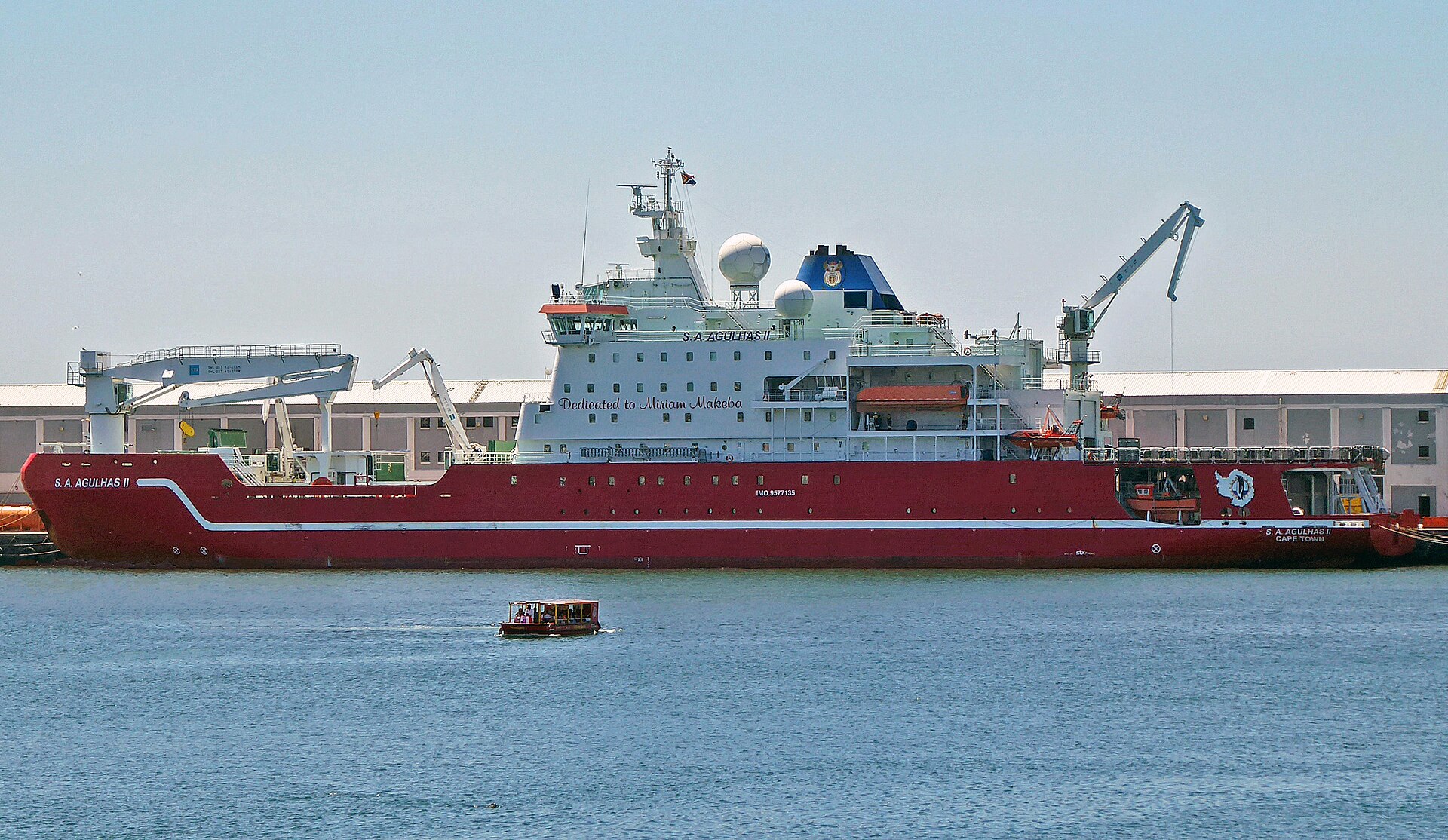
While the world debates climate change on land, South African scientists have been at sea, unlocking the secrets of one of Earth’s most powerful climate regulators. The ocean absorbs roughly a quarter of humanity’s carbon dioxide emissions, and understanding how it does so has become one of the defining scientific challenges of our time — a challenge South Africa is superbly placed to lead.
Writing for SAnews, Department of Forestry, Fisheries and the Environment scientists Dr Mutshutshu Tsanwani and Onele Nyengule describe their recent participation in the WHIRLS expedition aboard the country’s flagship research vessel, the SA Agulhas II, as a remarkable glimpse into the complexity of the ocean’s carbon cycle.
Chasing eddies in the Cape Basin
The expedition focused on the Cape Basin and the Agulhas Bank, regions alive with energetic ocean eddies that continually move heat, nutrients and carbon. Though they may look insignificant at the surface, these swirling features play an outsized role in the exchange of carbon dioxide between air and sea.
The team continuously measured seawater carbon dioxide, pH, dissolved inorganic carbon, total alkalinity and chlorophyll while collecting water samples from the surface down to 1 200 metres, across both cyclonic and anticyclonic eddies. That combination of high-resolution observations allowed the researchers to examine carbon dynamics with unprecedented detail.
Even the preliminary findings matter globally. Cyclonic eddies appear to draw carbon-rich deep water toward the surface, while anticyclonic eddies push surface waters downward, helping redistribute carbon into the deep ocean, proof that the ocean is a living, constantly changing system rather than a passive reservoir.
Why South Africa is uniquely positioned
Surrounded by three oceans, South Africa occupies a strategically important position in global ocean circulation. The interaction between the Agulhas Current, the Southern Ocean and the South Atlantic influences weather, biodiversity and carbon exchange far beyond our coastline, so observations collected in South African waters feed directly into international climate models.
The expedition also showcased homegrown talent. Collaboration between South African institutions and international partners, the scientists write, showed how shared expertise can advance knowledge while building national scientific capacity, with researchers working long hours at sea while mentoring the next generation.
An investment that pays dividends
Sustained ocean observation, the authors argue, is an investment in better climate forecasting, stronger environmental policy, resilient coastal economies and a thriving blue economy.
“South Africa is uniquely positioned to help answer that question, and the knowledge we generate today will shape the environmental decisions of tomorrow,” they conclude.
Read the scientists’ full account at SAnews.gov.za.
Photo: commons.wikimedia.org







.jpg)
Leave a Reply